Our E-Tube Feeding Experience
Our E-tube Experience
For those interested in the E-tube, we thought we’d share our experience in hopes of helping someone else care for their furry family members.
Bubbles is now a 5 month old kitten who was born with a midline cleft palate that extended back almost to his esophagus. At 11 weeks old, his e-tube was placed, and he weighed just 2lbs 2 oz. Since his tube was placed just over 8 weeks ago, he’s gained over 3lbs 7oz. He just had his cleft palate repaired on November 10th. It’s expected that he’ll have the tube for 2 more weeks to give his mouth time to heal, as well as use it as a port for his medication.
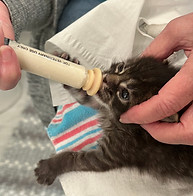
After we discovered his cleft palate, we began bottle feeding Bubbles 3cc every 3 hours around the clock. We used a syringe and a long nipple (The Original Miracle Nipple) to try to get the formula as far back in his mouth as possible. Feedings weren’t just a struggle, they were risky. Some formula still found its way up into the cleft and milk bubbles would invariably come out his nose. And as hard as we tried to prevent it, some of the formula went down into his lungs. We held him upright during feeding and gently patted him when he struggled to clear out his nose and throat. As Bubbles grew, we increased his formula and slowly added in Royal Canin Babycat Mousse into his formula in 1/4tsp increments. Even at such small amounts, the blended smoothie often caused sinusitis, and we’d have to cut back so his little body wasn’t working so hard. All the while we were constantly watching for and trying to prevent pneumonia. Our veterinarian, Dr Gutzmer, has been instrumental in caring for Bubbles. Even with his busy schedule, he’s made time for Bubbles every time we needed him to administer antibiotics, listen to his lungs, take X-rays, put in more stitches, or give us advice on next steps.
When deciding on a surgeon we called several surgical veterinary offices within a 5-hour driving distance and asked questions before we narrowed down our options to Phoenix Veterinary Surgical Specialists in Overland Park, KS, and K-State. It was important to us to find a clinic that we could communicate with easily. In addition, since Bubbles' surgery required him to stay overnight we needed to make sure they had 24-hour skilled nursing. (We found out that several places wouldn’t answer questions about their practice and procedures until the first appointment.)
We never made it to the consult appointment at K State. Once we met Dr Millard, we knew we had found Bubble’s surgeon. She explained the option of placing an E-tube, answered all of our questions, and left the decision up to us. Initially hesitant, we decided it was Bubbles' best chance of survival. Two days later, Dr Millard placed the tube. Her practice is very thorough. They formulated a custom smoothie recipe for him with the food he was already used to, based on his caloric intake needs. We dropped him off early in the morning and when we picked him up in the afternoon, the nurse went through everything with us. They sent us home with his smoothie, the recipe, syringes (Monoject Leur Lock Needleless Syringe), gauze, emergency phone numbers, pain medication, and information for cleaning/maintaining the tube. Since they didn’t have an e-tube collar small enough for our 2lb little guy, they even let us borrow one to use as a pattern.
We began with the 35 ml prescribed feedings every 3 hours, but Bubbles was struggling with massive amounts of foamy white nasal discharge so Dr Millard had us cut his feedings back significantly to 15ml for the first few days. We started him on a 2nd antibiotic that went directly into the feeding tube, ran a humidifier, and suctioned his nose often. Within a few days the nasal discharge significantly decreased, as well as his pain, and we were slowly able to increase his feedings.
Feedings take about 25 minutes to complete. His feedings begin with a few mL’s of warm water to flush out the tube. After 5 minutes we slowly administer his food, with Medications given in between syringes of food to ensure the medicine doesn’t sit in the tube. Afterwards, more water is given to flush the tube and the tube is secured under his collar. Initially, he was getting 6 meals a day, but as we’ve slowly increased the amount of food, we’ve also been able to increase the time in between feedings to 4 hours. Kitten tummies only hold so much volume, and overfeeding could make him vomit, which increases the risk of aspiration. We kept a log of his weight and submitted it weekly to Dr Millard so she could help decide when it was time to add a few more mL’s of food to his meals. We’ve also had to flush his tube a few times with Coca-Cola to try to clear the tube of small clogs. Since the E-tube placement he was on antibiotics less, but the chronic sinusitis was ongoing and expected until the palate was repaired.
The tube site is cleaned with Betadine spray and Bacitracin nightly, then fresh gauze is wrapped around his neck, and he gets a clean collar to hold his tube in place. He hasn’t had any infection around the tube, but the cleanings can be a little painful. Bubbles is such a trooper. He closes his eyes and breathes deep. Lots of head scratches and loves from his Myra make it all better.
Bubbles had his e-tube removed last Tuesday, 2 weeks after his cleft plate repair. It was a relatively quick procedure to remove the stitches and the tube. The site is healing well so we'll continue to clean the area for another 10 days and keep the collar on until it's completely healed to protect it from getting scratched.
Bubbles is enjoying his meals and growing stronger and healthier each and every day. We are now trying to transition him to regular canned food from the Royal Canin Babycat Mousse and introducing him to water. In about 10 days he'll be offered kitten kibble as well. He's also able to use regular cat litter now since we don't have to the worry of clay litter accidentally getting into his nasal passageway.
We'll update more about Bubbles later as his healing process continues. If you have any questions or know someone who does, reach out and we’d be happy to share more of our experience.
A few extra considerations and how we worked around them
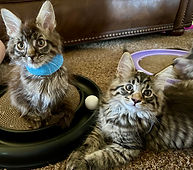
One of the issues we were concerned with is that kittens with cleft palates can’t have access to food and water. Most of the information we found online recommended separating him from his family and other pets to ensure he couldn’t accidentally eat or drink anything. We didn’t think it was in his best interest to be separated from his mother and siblings. To work around this, we gave his siblings their meals when we fed Bubbles. Yes, it was a little extra work, but it was worth it for him to be able to grow up and be surrounded by his Mom and his sweet siblings.
After his e-tube was placed, we always supervised Bubbles when he was around the adult cats and his siblings because it took Myra and I a little while to design a collar that would fully cover and protect the tube. Most of the e-tube collars that we saw online were VERY expensive, and while they secured the tube in place, they left the tube exposed. This was a major concern since we didn’t want a sibling, his mom, or him to accidentally bite the tube and then need it replaced. After trying a few different designs we made one that secures the tube and has a flap that completely covers the tube with Velcro, giving us easy access to the tube at feeding time. It was a good thing he had a collar that stayed in place, because he tried to convince his Mom and siblings to help him take it off!!
One of the other concerns we had was that the clay litter could easily get into his nose and cause an infection. Because of his small size we gave him a shorter litter box with paper pellet litter. Even though it’s next to his siblings' litter box he’s always been content to use his litter box. Bottle feeding and e-tube feeding are a lot of work AND they are doable.

.jpg)
.jpg)
.jpg)
.jpg)
.jpg)
.jpg)
.jpg)
.jpg)
.jpg)


.jpg)
.jpg)
Pictures Below


.jpg)